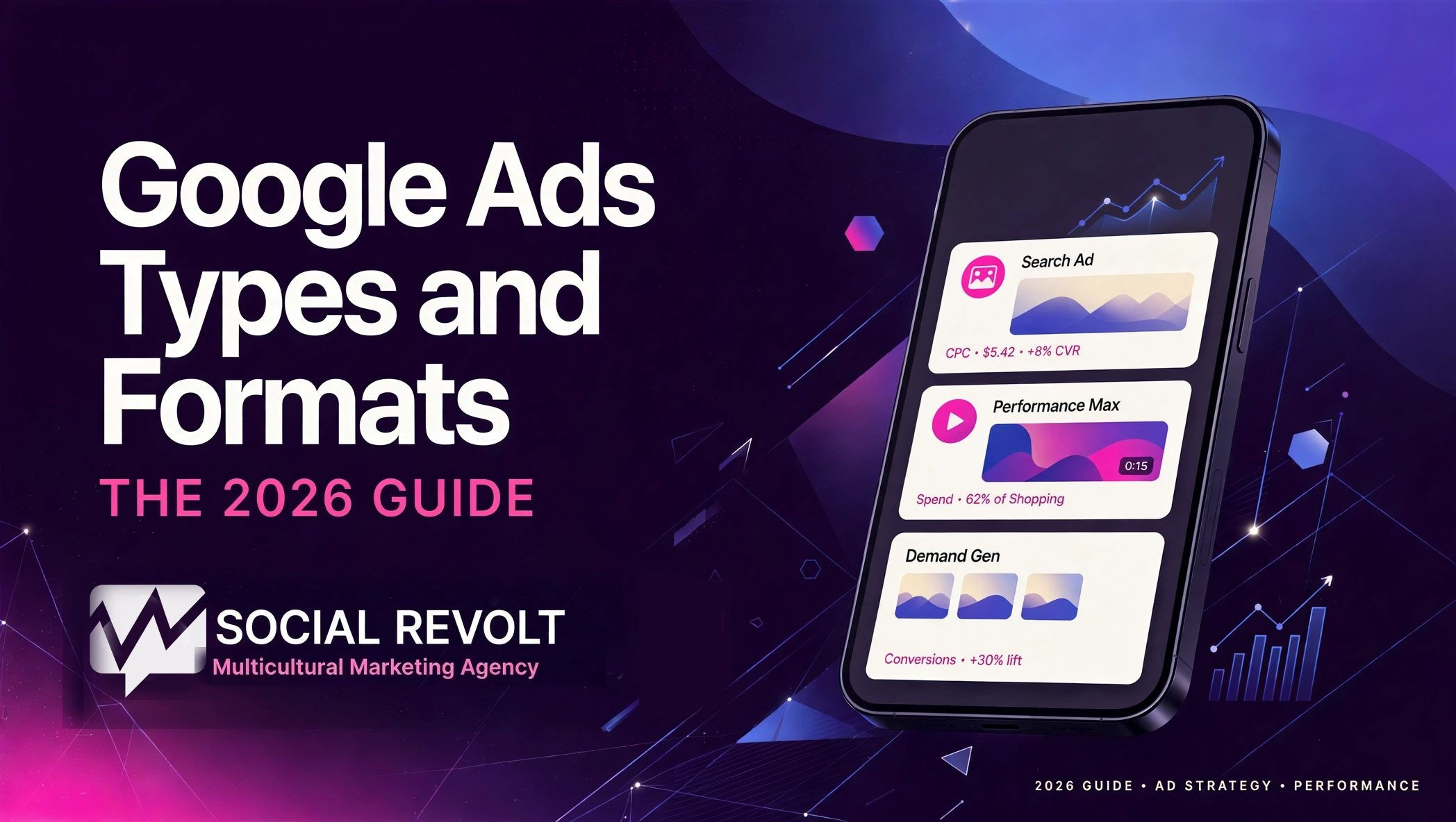

TL;DR: Google organizes ads by campaign type, and the eight that matter in 2026 are Search, Performance Max, Demand Gen, YouTube video, Display, Shopping, App, and Smart campaigns. The average click cost $5.42 with an 8.18% conversion rate, AI Max left beta in April 2026 and now rewrites ad text on the fly, and new call-only ads can no longer be created. Standalone Display campaigns are migrating into Demand Gen, and AI Overviews have cut paid click-through on informational queries, so brands cited inside the answer now earn more paid clicks.
The average Google Ads click cost $5.42 in the year ending March 2026, up from $4.66 two years earlier, according to WordStream’s analysis of 13,474 US campaigns. Clicks keep getting more expensive, and yet conversion rates climbed to 8.18% while cost per lead fell for the first time in five years. That tension defines Google Ads in 2026: pricier traffic, better conversion efficiency, and an automation layer touching nearly every campaign type. AI Max graduated from beta in April 2026, new call-only ads can no longer be created as of February 2026, and Display campaigns are mid-migration into Demand Gen. This guide covers the types of Google ads as they exist right now, with current specs and the numbers behind them.
One structural note before the list. Google organizes everything by campaign type first, and the ad format follows from it. Thinking in campaign types keeps you aligned with how the platform works.
1. Search campaigns
Search is still the highest-intent inventory on the internet: text ads shown against queries people typed themselves. The expanded text ad is long gone, sunset in June 2022, and the responsive search ad is the only text format that matters now. You supply up to 15 headlines at 30 characters each and four descriptions at 90 characters each, and Google assembles the combinations it thinks will win each auction. Pinning headlines to fixed positions is possible, but every pin reduces the combinations Google can test, so pin sparingly and only where the message cannot move.
The big 2026 change inside Search is AI Max. Google announced it in May 2025 as an optimization layer for standard Search campaigns, and it reached general availability in April 2026. It expands matching beyond your keywords, rewrites ad text on the fly, and can redirect users to different landing pages based on the query. Google’s current claim is 7% more conversions at similar cost per acquisition when using the full feature suite. Independent testing tells a cooler story: Smarter Ecommerce reviewed more than 250 retail campaigns and found a median 13% lift in conversion value alongside a 16% rise in cost per acquisition, with zero median change in return on ad spend. One analyst called it essentially a coin toss. The forced migration is coming: campaigns using automatically created assets or campaign-level broad match auto-upgrade starting September 2026, and Dynamic Search Ads follow in February 2027 after Google extended the original deadline. Google is rolling out upgrade tools that port DSA settings and history into standard ad groups, plus one-click experiments to test the impact first. Test AI Max as an experiment with brand controls set, not as a switch you flip account-wide on day one.
A separate sunset matters for lead-gen advertisers. Google stopped creation of new call-only ads in February 2026, and existing ones stop serving entirely in February 2027. The replacement is responsive search ads with call assets, plus call reporting and call conversions set as a primary goal. If phone calls drive your business, migrate now rather than waiting for the deadline to force it.
2. Performance Max
Performance Max runs one campaign across Search, Display, YouTube, Discover, Gmail, and Maps from a single budget and a set of creative assets. You feed it headlines, images, video, and audience signals, and Google decides where each impression goes. By the fourth quarter of 2025 it accounted for roughly 62% of Google Shopping spend and 61% of Shopping sales among Tinuiti’s advertisers, with about 39% of Performance Max budgets flowing into non-Shopping inventory like YouTube and display.
The honest version: Performance Max works best as a complement, not a replacement. Optmyzr’s study of 24,702 campaigns found its cost per click runs about 50% cheaper than Search, thanks to the cheaper visual inventory in the mix, and the best conversion efficiency showed up when it held 10 to 25% of account budget. Accounts that handed it everything often watched it cannibalize branded search volume that would have converted anyway. Feed quality decides more than settings do. Clean product data, real conversion volume, and honest targets beat clever campaign structures every time.
3. Demand Gen
Demand Gen is Google’s answer to paid social, built for creating demand rather than capturing it. It replaced Discovery ads in 2023, absorbed the last Video Action campaigns by April 2026, and is now absorbing Display too: Google began rolling out a Display-to-Demand Gen migration tool in June 2026, with automatic migration of remaining campaigns expected in 2027. Surfaces include YouTube in-stream, in-feed, and Shorts, plus Discover and Gmail.
The format keeps gaining capability. In the second half of 2025 Google reported Demand Gen driving roughly 30% more conversions or conversion value for advertisers on average. The September 2026 product drop added one-click image ads on YouTube Shorts and Gmail, an AI assistant that answers product questions alongside video ads, and promoted location pins in Google Maps. Advertisers who upload both video and image assets see about 20% more conversions at the same cost per acquisition than video-only advertisers. If your creative is strong and your goal is new customer acquisition rather than harvesting existing demand, this is the campaign type to learn first.
4. Video campaigns on YouTube
YouTube remains the second-largest search engine in the world and a full-funnel ad platform in its own right. The format menu: skippable in-stream ads, 15-second non-skippable, 6-second bumpers, in-feed placements, and Shorts. Shorts deserve their own creative, not a cropped landscape video. Vertical, captioned, and hook-first wins there the same way it does on every other short-form surface.
Connected TV keeps taking share of YouTube viewing, which changes what “video creative” means. An ad built for a phone screen held 18 inches from a face reads differently on a 55-inch screen across the room. Bigger type, simpler compositions, and branding that lands in the first three seconds travel better across both.
5. Display campaigns
Display is the original Google ad format and the one currently being retired as a standalone campaign type. Responsive display ads assemble your headlines, images, and logos into whatever size each placement needs. One caution on benchmarks: the widely quoted 0.46% click-through rate and $0.63 cost per click figures are recycled pre-2020 data. No fresh large-sample public Display study exists, so treat those numbers as unknown rather than quoting them.
The practical move in 2026 is to stop building new standalone Display campaigns and plan the migration to Demand Gen, which adds Discover, YouTube, Gmail, and Maps inventory on top of the Display network. Google’s migration tool carries 42 days of performance history across, so the new campaign relearns in days rather than weeks.
6. Shopping campaigns
Shopping ads show product images, prices, and merchant names directly in search results, and they remain the highest-intent format in ecommerce. Advertisers have two paths: standard Shopping campaigns with product-group control, or Performance Max with a product feed. In accounts running both side by side, December 2025 return on ad spend landed nearly identical at 680% for Performance Max and 666% for standard Shopping, which suggests catalog economics matter more than the campaign label.
Two 2026 developments to know. Google extended AI Max to Shopping campaigns in April 2026, reading feed attributes to match conversational queries and generate text customization. And Local Services Ads began migrating into Performance Max with pay-per-lead goals in August 2026, moving campaign management from the separate Local Services dashboard into Google Ads. Either way, feed quality is the whole game: accurate titles, competitive prices, and complete attributes.
7. App campaigns
App campaigns promote mobile apps across Google Play, Search, YouTube, and the Display network from a single setup. You provide text, images, and video, and Google’s automation builds the ads and finds the users most likely to install or take in-app actions. Bidding centers on install volume, in-app actions, or in-app action value. The format suits developers and subscription apps far more than it suits local businesses, and it needs real install volume before the automation has anything to learn from.
8. Smart campaigns
Smart campaigns are the stripped-down option for small businesses: pick a goal, set a budget, write a few ads, and Google handles the rest. They work for advertisers with no dedicated marketing staff and simple objectives like calls or store visits. The tradeoff is control. Anyone spending meaningful budget outgrows Smart campaigns quickly, and graduating to standard Search is usually the first real optimization an account ever gets.
AI Overviews are reshaping paid search
No 2026 guide is complete without the AI Overviews question. Seer Interactive analyzed 3,119 informational queries across 42 organizations from June 2024 through September 2025 and found paid click-through rates on queries triggering an AI Overview fell 68%, from 19.7% to 6.34%. Brands cited inside the AI Overview earned 91% more paid clicks than brands that were not cited. That last number points to the opportunity: visibility inside the answer is becoming its own placement.
Treat the headline figure with care. In April 2026 the same research team published a follow-up on a sample roughly 270 times larger that put paid click-through on AI Overview queries at 16.21%, and neither study was retracted. The statistic is contested and sample-dependent. What holds across both: branded and high-intent transactional queries show far more resilience than non-branded informational ones, and advertisers bidding on informational keywords where AI Overviews appear are capturing a fraction of the clicks they got two years ago. Getting cited starts with the same content and authority work as ranking, which is why paid search and organic strategy keep converging.
Specs cheat sheet for 2026
Three specs cover most of what you will build. Responsive search ads: up to 15 headlines at 30 characters, four descriptions at 90 characters, pin sparingly. Demand Gen: headlines up to 40 characters with at least one under 30, descriptions at 90, video over 15 seconds to stay eligible across formats. YouTube: 6-second bumpers, 15-second non-skippable, vertical and captioned for Shorts. Retiring or retired: expanded text ads (2022), Discovery ads (2023), Video Action campaigns (April 2026), call-only ads (creation ended February 2026, full sunset February 2027), standalone Display (migrating through 2027).
For a deeper look at how the social side compares, see our Meta Ads types and formats explained and programmatic ads types and formats explained.
Types of Google ads: frequently asked questions
How much do Google Ads cost in 2026?
WordStream’s 2026 benchmarks put the average cost per click at $5.42, with a 6.64% click-through rate, an 8.18% conversion rate, and a $66.69 average cost per lead. Legal services pay the most at $8.58 to $9.21 per click, while arts and entertainment sits near $1.60. Your industry matters more than the overall average.
Should I run Performance Max or standard Search and Shopping?
Run both and compare inside your own account. Benchmarks show Performance Max performing best at 10 to 25% of account budget, and side-by-side tests show nearly identical returns between the two for Shopping. Your catalog economics and conversion volume matter more than the campaign label.
What is AI Max and should I turn it on?
AI Max is Google’s AI layer for Search campaigns: broader matching, rewritten ad text, and dynamic landing pages. It left beta in April 2026. Google claims 7% more conversions at similar cost when using the full feature suite. Independent tests show mixed results with rising costs per acquisition. Test it as an experiment with brand controls before rolling it out widely.
Are call-only ads still available?
No new call-only ads can be created since February 2026, and existing ones stop serving in February 2027. Move phone-call campaigns to responsive search ads with call assets now.
How are AI Overviews affecting Google Ads?
Paid click-through on queries with AI Overviews fell sharply in 2025 studies, though the exact magnitude is debated. Branded and high-intent transactional queries hold up best. Brands cited inside the AI Overview earn substantially more paid clicks, so content authority now feeds paid performance.
What is the difference between AI Max and Performance Max?
AI Max is an optimization layer that sits on top of standard Search campaigns: it expands matching beyond your keywords, rewrites ad text on the fly, and can send users to different landing pages based on the query. Performance Max is a separate campaign type that runs one budget across Search, Display, YouTube, Discover, Gmail, and Maps. One upgrades your Search campaigns, the other replaces the campaign structure entirely.
What are Demand Gen campaigns?
Demand Gen is Google’s paid-social answer, built for creating demand instead of capturing it. It replaced Discovery ads in 2023, absorbed the last Video Action campaigns in April 2026, and is now absorbing Display as well. It runs across YouTube in-stream, in-feed, and Shorts, plus Discover and Gmail, and it suits advertisers with strong creative chasing new customers rather than harvesting existing demand.
When do I have to migrate my Display campaigns to Demand Gen?
Google rolled out a Display-to-Demand Gen migration tool in June 2026, and automatic migration of the remaining campaigns is expected in 2027. The practical move now is to stop building new standalone Display campaigns entirely. The migration tool carries 42 days of performance history across, so the new campaign relearns in days rather than weeks.
Sources
- WordStream 2026 Google Ads benchmarks (13,474 US campaigns, Apr 2025 to Mar 2026): CPC $5.42, CTR 6.64%, CVR 8.18%, CPL $66.69: https://www.wordstream.com/blog/2026-google-ads-benchmarks
- WordStream 2025 benchmarks via Search Engine Land (16,000+ campaigns): CPC $5.26, CTR 6.66%, CVR 7.52%, CPL $70.11: https://searchengineland.com/google-ads-costs-keep-rising-but-conversion-rates-improved-in-2025-477927
- AI Max mixed real-world results, Smarter Ecommerce 250-campaign study, GA April 2026, DSA auto-upgrade September 2026: https://www.webpronews.com/googles-ai-max-delivers-mixed-conversion-gains-as-auto-migration-hits-search-campaigns/
- Google DSA to AI Max upgrade timeline (updated June 11, 2026): ACA and broad match auto-upgrade September 2026, DSA auto-upgrade extended to February 2027, 7% conversion claim: https://blog.google/products/ads-commerce/dsa-upgrade-to-ai-max-2026/
- AI Max extended to Shopping campaigns, April 30, 2026: https://ppc.land/google-brings-ai-max-to-shopping-campaigns-targeting-conversational-queries/
- Call-only ads sunset: creation ended February 2026, full sunset February 2027: https://searchengineland.com/google-to-phase-out-call-only-ads-by-2027-462983
- Demand Gen September 2026 product drop (one-click Shorts and Gmail ads, AI Business Agent, Maps affiliate pins): https://blog.google/products/ads-commerce/demand-gen-drop-september-2026/
- Demand Gen August 2026 product drop (DM links, travel features, multimodal video creation): https://blog.google/products/ads-commerce/demand-gen-drop-august-2026/
- Demand Gen September 2026 features via Social Media Today (Gmail 40% conversion lift): https://www.Socialmediatoday.com/news/google-provides-more-demand-gen-ad-features/831330/
- Tinuiti Q4 2025: Performance Max 62% of Google Shopping spend, 61% of Shopping sales: https://almcorp.com/blog/google-search-ad-clicks-q4-2025-benchmarks/
- Optmyzr Performance Max study (24,702 campaigns): CPCs ~50% cheaper than Search, best at 10 to 25% of budget: https://www.optmyzr.com/blog/performance-max-2025-updates-study-analysis/
- Seer Interactive AI Overviews CTR study, September 2025 update (3,119 queries, 42 organizations): https://www.seerinteractive.com/insights/aio-impact-on-google-ctr-september-2025-update
- Seer stat revision caveat, April 2026 follow-up on larger sample: https://semoptimize.com/blog/ai-overviews-paid-search-ctr/
- Paid search pivots for AI Overviews via Search Engine Land: https://searchengineland.com/paid-search-pivots-google-ai-overviews-470193
Google’s ad platform rewards advertisers who match the campaign type to the job instead of forcing one format to do everything. Search captures intent, Performance Max scales winners across networks, Demand Gen creates demand that did not exist yet, and YouTube builds the brand memory that makes every other click cheaper. Pick the right tool for the quarter you are in, test the automation with guardrails instead of blind trust, and let your own account data settle every debate the benchmarks start.