
TL;DR: Every Meta ad starts as one of four creative containers: single image, video, carousel, or collection, and Reels and Stories now run on 9:16 vertical video built around safe zones. Partnership ads turn a creator’s post into a paid placement, lead and click-to-message ads skip the landing page entirely, and Advantage+ automation now touches audience, placement, and creative across most campaigns. Store Traffic and Offer ads are gone, Threads opened to advertisers in January 2026, and Advantage+ catalog ads pull products straight from your feed for ecommerce.
Meta reported 3.60 billion daily active people across its apps in June 2026, up 3% from a year earlier, and ad impressions grew 14% in the same quarter. That is the scale of the inventory you are buying into. What changed is how you buy it. Threads opened to advertisers globally in January 2026, Reels now eats half of all time spent on Instagram, and most advertisers have handed at least part of their targeting to Advantage+ automation. This guide breaks down the types of Meta ads as they exist right now, with current specs and the numbers behind them.
The four formats everything is built on
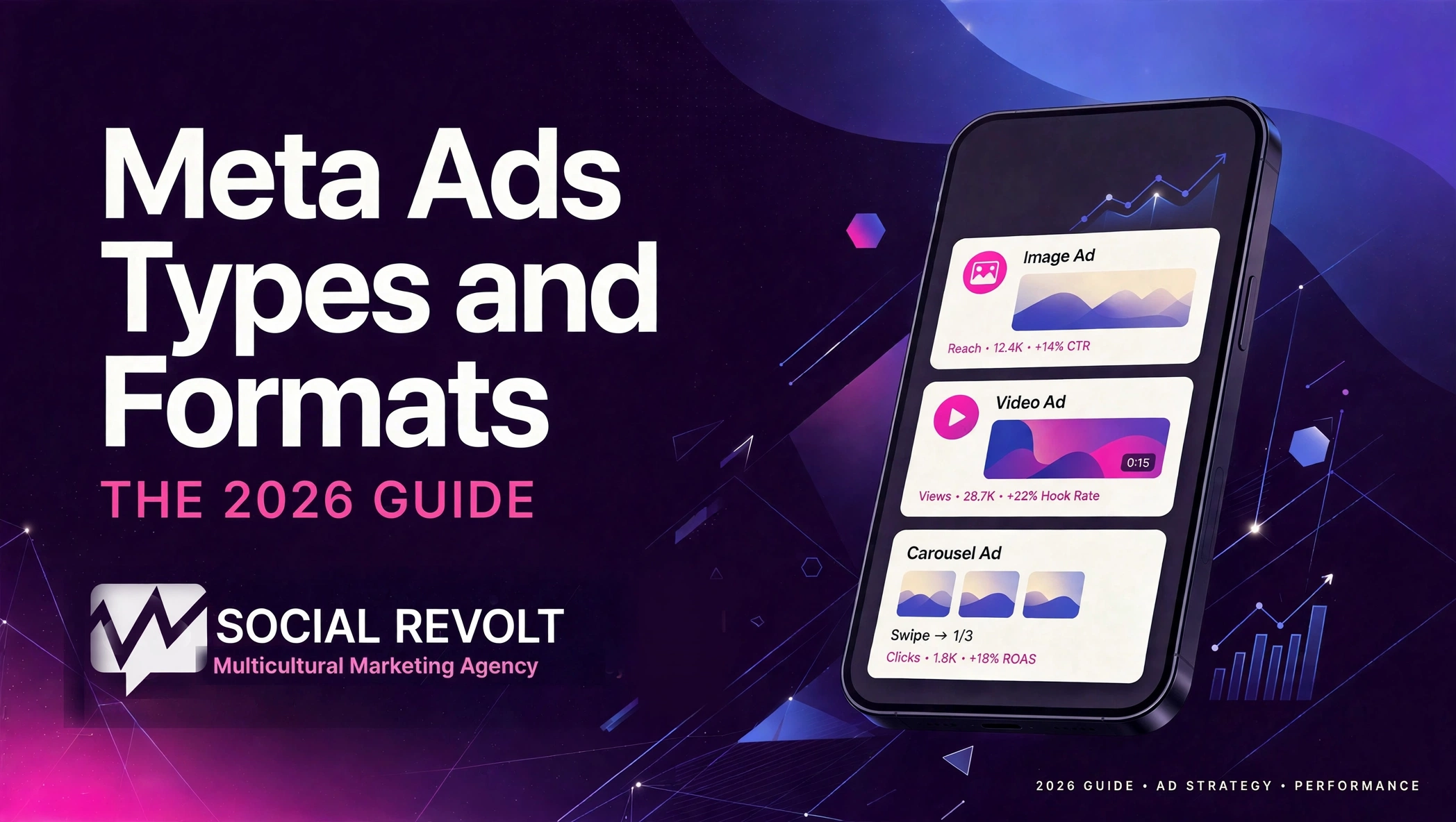
Every ad you build in Ads Manager starts as one of four visual containers. Placements, objectives, and automation layer on top, but the creative itself is always one of these.
1. Single image ads
One frame, one message. Still the fastest and cheapest format to produce, which makes it the default for testing offers and retargeting warm audiences.
Current specs: 1080 x 1080 (1:1) or 1080 x 1350 (4:5). JPG or PNG, under 30 MB. Keep primary text under 125 characters and headlines under 40. The 4:5 vertical takes up noticeably more screen space than square on mobile, and Meta recommends it as the default Feed size for 2026.
Use image ads when the idea lands in a single frame: a product shot, a promotion, an announcement. A common setup is 4:5 product shots retargeted to site visitors from the past 30 days, treated as the baseline every other format has to beat.

2. Video ads
Motion does selling that stills cannot: demos, proof, personality. Fifteen to thirty seconds is the sweet spot for Feed, and vertical is no longer optional.
Current specs: MP4 or MOV, up to 4 GB. Use 9:16 (1080 x 1920) for Reels and Stories, 4:5 or 1:1 for Feed. Front-load the hook in the first three seconds, because most viewers decide that fast whether to keep watching.
Shoot for the placement. A square video cropped into a 9:16 slot looks broken, and Meta will happily spend your budget serving it that way. Build the vertical version first, then adapt down, not the other way around.
3. Carousel ads
Two to ten swipeable cards, each with its own image or video, headline, and link. The format for sequence and comparison: step-by-step routines, product lineups, before-and-after stories, feature tours.
Current specs: 1080 x 1080 per card (1:1 is required), JPG, PNG, or MP4. Every card can carry its own destination URL, so a single ad can send different shoppers to different product pages.
Carousels earn their keep in retargeting. Someone who viewed three products gets all three in one ad, and Meta learns which card pulls each person. For catalogs under a few dozen SKUs, a well-built carousel often beats a fancier format on cost per result.

4. Collection ads
A cover image or video above a grid of products. One tap opens a full-screen Instant Experience that feels like browsing a mini storefront without leaving the app. Mobile only, catalog connected, at least four products in the grid.
This is the ecommerce workhorse. Discovery, browsing, and checkout happen inside one tap, which is why collection and its automated sibling, Advantage+ catalog ads, dominate paid social for retailers. If you sell products online and you are not running these, you are leaving the highest-intent format on the table.
Reels and Stories run on vertical video
Reels passed 2 billion monthly users in 2026, generate around 200 billion plays a day across Instagram and Facebook, and now account for roughly half of all time spent on Instagram. Meta says Reels crossed a $50 billion annual ad revenue run rate. Brands that built Reels into their strategy saw an average 29% lift in ROI, and Reel ads drive 41% higher click-through to brand sites than static ads, with 55% of views coming from people who do not follow the account.
The practical takeaway is simple. Every campaign needs a 9:16 version of its creative at 1080 x 1920, designed with safe zones in mind, because interface overlays eat the top and bottom edges of the frame. Keep text and logos clear of those zones or your call to action sits under a username tag. Since July 2025, Google indexes public Reels too, so a strong Reel can now pull search traffic on top of in-app discovery.
Partnership ads borrow someone else’s trust
Meta renamed branded content ads to partnership ads, and the format lets a brand run a creator’s post as a paid ad with the creator’s handle as the primary identity. It reads as native to the feed because it comes from an account people chose to follow.
Meta’s early tests found campaigns combining partnership ads with regular ads drove 53% higher click-through rates and 19% lower cost per action, with a 99% probability of beating regular ads alone. In September 2026 Meta merged Creator Marketplace and the Partnership Ads Hub into a single Creator Marketing Hub, so brands can now find creators, message them, and turn their posts into ads without leaving the platform. For influencer-led brands, this is the bridge between organic creator content and paid scale.
Lead ads and click-to-message
Not every campaign needs a landing page. Lead ads open a native instant form inside the app, which removes the slowest step in mobile conversion. Click-to-message ads start a Messenger, Instagram, or WhatsApp conversation instead of pushing a click, and they fit businesses where the sale needs a human exchange first: home services, automotive, education, high-consideration B2B.
Advantage+ and the automation question
Advantage+ is Meta’s AI layer across audience, placement, and creative, and adoption is wide: 65% of advertisers now scale campaigns through it, Meta reports an average 18% ROAS improvement, and advertisers using it see about $4.52 back per dollar spent, roughly 22% better than manually built campaigns.
The nuance matters. Tinuiti’s Q1 2026 benchmark data shows Advantage+ sales campaigns fell from 38% of retail Meta spend in early 2025 to 20% a year later, as advertisers pulled budget back toward structures they control. Automation performs best on consolidated campaigns with clean conversion signals and human oversight, not as a set-and-forget switch. Test it against a controlled manual structure before handing it the whole budget.
Playable ads let people try before they install
Playable ads are interactive mini-demos for mobile apps and games. The ad opens with a short lead-in video and a Tap to Try prompt. One tap drops the viewer into a playable slice of the app, full screen, with a call to action running through the demo or when it ends.
Per Meta’s developer documentation, playable ads run on Facebook Feed, Facebook Stories, Instagram Feed and Stories (through Placement Asset Customization), and Audience Network interstitial and rewarded placements. They are only available under the App Promotion objective. You build them from a lead-in video plus an HTML or zip file of the demo, uploaded in Ads Manager.
The format exists for one reason: install quality. Meta’s gaming research found people who installed through a playable ad opened the app 60% more often and were six times more likely to make an in-app purchase than people who installed through other ads for the same apps. Bagelcode tested them and reported a 3.2x improvement in ROAS on Android, and Rovio saw a 40% lower cost per paying user. If you market an app, test playable creative against your standard video app ads before deciding video wins.
Advantage+ catalog ads: the automated ecommerce engine
Collection ads earned a section earlier. Their automated sibling deserves its own. Advantage+ catalog ads pull products straight from your catalog and assemble a personalized ad for each viewer based on what they browsed, added to cart, or bought. No manual creative per product. One feed powers thousands of placements across Feed, Reels, Stories, and, since October 2025, Threads (image and carousel only there so far).
Setup runs through Commerce Manager: connect the catalog, map the feed fields, pass Diagnostics, and allow 24 to 48 hours for approval. Since October 20, 2025, all new Advantage+ catalog ads must include Dynamic Media, which automatically builds creative variations from your product assets.
The requirement is clean signal. A pixel firing purchase events plus the Conversions API is the price of admission. With that in place, this format carries most scaled ecommerce spend on Meta. Without it, the automation is guessing, and your results will show it.
Instant Experience: the full-screen format hiding inside Collection
Collection ads open into an Instant Experience, but the format stands alone too. Instant Experience (the old Canvas, renamed in 2018) is a full-screen, mobile-only canvas that loads natively inside the app. No browser redirect, no load spinner, no bounce on a slow connection.
Meta ships five pre-built templates tuned to different goals: storefront browsing, brand storytelling, lead capture, and more. You can layer video, images, carousels, tilt-to-pan panoramas, and tagged products in one unit, up to 20 media assets. The engagement case is simple: more than half of the people who tap in view at least half of the content.
Use it when the story needs more room than a single placement allows: launches, lookbooks, event promotion. Build at 1080 x 1920 and make the first screen count, because the tap is the whole game.
Collaborative ads: when the brand and the retailer split the work
Collaborative ads (CPAS, short for Collaborative Performance Advertising Solutions) let a brand run ads using a retail partner’s catalog and sales data. The retailer shares a catalog segment with the brand. The brand accepts it and runs Advantage+ catalog ads against it, sending shoppers to the retailer’s store. The brand cannot edit the shared segment, but it can build its own product sets from it.
The appeal is the data. The brand gets retailer purchase signals for targeting and measurement without owning the transaction. Meta’s quick-commerce case studies in India put numbers on it: Coca-Cola used retailer-linked catalog signals on its sugar-free portfolio and saw a 39% ROAS improvement with conversion rates 2.5x stronger than broad audiences. Britannia cut cost per purchase 45% quarter over quarter across Blinkit, Swiggy, and Zepto.
This only works where the partnership exists. Marketplaces and retail chains across Southeast Asia, Latin America, and quick-commerce markets run formal CPAS programs. If you sell through retailers instead of direct, ask your retail partners whether they support catalog sharing before writing this format off.
App Promotion: the renamed home of app ads
The old App Installs objective is now App Promotion, one of the six ODAX objectives. Installs, in-app events, and value optimization for high-LTV users all live here.
Standard app ads use the same creative containers (image, video, carousel, playable) pointed at an app store destination. One deadline matters: on May 19, 2026, Meta blocked creation of legacy Advantage+ App campaigns under the unified Advantage+ structure. Existing legacy campaigns keep delivering but cannot be duplicated or significantly edited. If anything is still running on the old structure, migrate it.
Two practical notes. First, iOS App Tracking Transparency still throttles signal, so pair every app campaign with the Conversions API. Second, for games in particular, test playable creative against standard video. The format with the demo usually wins on payer quality, not just install volume.
What replaced Store Traffic and Offer ads
Two formats readers of older guides will look for are gone. Meta sunset the Store Traffic objective (new campaigns were disabled in January 2024) and it has no ODAX replacement. Offer ads were removed entirely.
For foot traffic, the current playbook is an Awareness campaign with tight radius targeting around each location, a store locator on the destination, and offline conversion uploads wiring visit data back into Meta’s reporting. Reach and ad recall are the optimization levers now. There is no dedicated store-visits objective anymore.
For promotions, the discount moved into the creative. Put the offer in the primary text, the headline, and the visual, and pair it with a Shop Now or Get Offer call to action. Nothing structural was lost. The claim lives in the ad instead of a dedicated unit.
Specs cheat sheet for 2026
Three sizes cover nearly every placement: 4:5 (1080 x 1350) for Feed, 9:16 (1080 x 1920) for Stories and Reels, 1:1 (1080 x 1080) as the universal fallback. Keep primary text under 125 characters and headlines under 40. New since the last version of this guide: Threads Feed ads take image, video, and carousel as of January 2026, and the scrollable Instagram Explore feed is gone, leaving grid tiles only, with that attention flowing into Reels.
For a deeper look at how search-side formats compare, see our Google Ads types and formats explained and programmatic ads types and formats explained.
Types of Meta ads: frequently asked questions
How much do Meta ads cost in 2026?
It depends on placement and season. Recent benchmarks put average Facebook cost per click near $1.11 with CPMs between roughly $13 and $20, peaking above $25 in November during holiday competition. Instagram runs $1.83 to $3.35 per click depending on placement. Meta CPMs rose about 20% year over year in 2025, and costs always spike in Q4 and drop in January and February.
Which Meta ad format performs best?
No single format wins everywhere. Reels deliver the cheapest reach and strongest discovery right now, carousels and collection ads convert best for ecommerce retargeting, and single image remains the most efficient testing format. The honest answer is that creative quality moves results more than format choice.
What size should my Meta ad creative be?
Build at 1080 x 1350 (4:5) for Feed, 1080 x 1920 (9:16) for Stories and Reels, and 1080 x 1080 (1:1) when you can only make one version. Respect safe zones on vertical video so interface overlays do not cover your text.
Should I use Advantage+ or build campaigns manually?
Run both and compare. Advantage+ shows real ROAS lifts in Meta’s data, but the advertisers getting those lifts restructured and consolidated first. Keep a controlled manual campaign as your baseline and let the numbers decide how much budget the automation earns.
Do Reels ads outperform Feed ads?
On reach and discovery, yes: Reels average a 30.81% reach rate, more than double carousels, image posts, and Stories, and over half of views come from non-followers. Feed still wins on conversion intent for many categories. Run Reels for cold audiences and Feed formats for retargeting, then shift budget to whatever the data favors.
What are Meta partnership ads?
Partnership ads are what Meta now calls branded content ads. A brand runs a creator’s post as a paid ad, and the creator’s handle shows as the primary identity, so it reads native in the feed. In September 2026 Meta merged the Creator Marketplace and the Partnership Ads Hub into one Creator Marketing Hub, so brands can find creators, message them, and turn posts into ads without leaving the platform.
What replaced Store Traffic and Offer ads?
Nothing replaced them directly. Meta disabled new Store Traffic campaigns in January 2024 with no ODAX equivalent, and Offer ads were removed entirely. For foot traffic, the current playbook is an Awareness campaign with tight radius targeting around each location, a store locator on the destination, and offline conversion uploads feeding visit data back into reporting. For promotions, the discount now lives in the creative itself: primary text, headline, visual, and a Shop Now or Get Offer call to action.
How do Advantage+ catalog ads work?
They pull products straight from your catalog and assemble a personalized ad for each viewer based on what they browsed, added to cart, or bought. Setup runs through Commerce Manager, approval takes 24 to 48 hours, and since October 20, 2025 every new catalog ad must include Dynamic Media, which builds creative variations from your product assets automatically. The non-negotiable is clean signal: a pixel firing purchase events plus the Conversions API, or the automation is guessing.
Sources
- Meta Platforms Q2 2026 10-Q: 3.60B family daily active people (June 2026), ad impressions +14%, average price per ad +12%: https://www.stocktitan.net/sec-filings/META/10-q-meta-platforms-inc-quarterly-earnings-report-393f7af5508d.html
- Meta Q2 2026 results summary ($60.8B revenue, +28% YoY): https://pulse2.com/meta-reports-second-quarter-2026-revenue-of-60-8-billion-up-28-percent-year-over-year/
- Meta ad formats explained 2026 (four core formats + layers): https://admanage.ai/blog/meta-ad-formats-explained
- Meta ad sizes, dimensions, and placements 2026 (Threads ads Jan 2026, Explore feed removal): https://theoptimizer.io/blog/every-meta-ad-size-you-need-in-2026-dimensions-formats-and-placements-complete-guide
- Meta ad specs quick reference 2026: https://riversagency.com/meta-ad-specs
- Advantage+ $75B annualized revenue, $4.52 per $1 spent: https://www.webpronews.com/metas-60-billion-ai-bet-how-massive-data-center-spending-powers-ad-gains-and-tests-investor-patience/
- Advantage+ adoption (65% of advertisers, 18% ROAS lift): https://medium.com/@automation.labs/what-advantage-really-means-for-ads-ops-and-what-you-still-have-to-do-be446b801fe8
- Tinuiti Q1 2026 Digital Ads Benchmark Report (Advantage+ spend share 38% to 20%, Reels impression share, Instagram CPM -3%): https://storage.pardot.com/1062992/1776110516rTHB8lKD/Tinuiti_Q1_2026_Digital_Ads_Benchmark_Report.pdf
- Instagram Reels statistics Q1 2026 (50% of IG time, 30.81% reach rate, 55% non-follower views, 29% ROI lift): https://www.loopexdigital.com/blog/instagram-reels-statistics
- Reels $50B ad run rate, Google indexing Reels (July 2025): https://virvid.ai/blog/ai-instagram-reels-ultimate-guide-2026
- B2B advertising benchmarks 2026, 2025 data (Facebook CTR 0.79% / CPC $1.95, Instagram CTR 0.65% / CPC $2.82): https://metadata.io/b2b-advertising-benchmarks
- Facebook/Instagram ad cost benchmarks 2026 (CPC, CPM ranges, Triple Whale CPM +20% YoY): https://www.pravaahconsulting.com/post/how-much-do-facebook-and-instagram-advertising-cost-in-2022
- Partnership ads performance (53% higher CTR, 19% lower CPA): https://searchengineland.com/instagram-has-rebranded-content-ads-to-partnership-ads-409470
- Meta Creator Marketing Hub launch (September 2026): https://balleralert.com/meta-creator-marketing-hub-launches/
- Playable ads documentation (Meta for Developers — placements, App Promotion objective requirement, HTML/zip build): https://developers.facebook.com/docs/app-ads/formats/playable-ad/?locale=en_US
- Meta announcement for gaming marketers (Bagelcode 3.2x ROAS on Android, Rovio 40% lower cost per paying user): https://developers.facebook.com/ads/blog/post/2018/08/02/gaming-marketers/?locale=en_US
- Meta playable ads expansion (app opened 60% more often, 6x more likely to make in-app purchase): https://www.marketing-interactive.com/facebook-expands-playable-ads-and-rewarded-video-formats
- Advantage+ catalog ads on Threads (October 28, 2025, image and carousel only): https://ppc.land/meta-expands-advertising-formats-on-threads-with-catalog-ads/
- Advantage+ timeline (Dynamic Media default September 1 2025, enforced October 20 2025; unified Advantage+ structure mandatory May 19 2026): https://ppc.land/advantage/
- Collaborative ads documentation (Meta for Developers, updated December 13, 2025 — catalog segment sharing, brand cannot edit segment): https://developers.facebook.com/documentation/ads-commerce/marketing-api/collaborative-ads
- Collaborative ads quick-commerce results (Coca-Cola 39% ROAS improvement, Britannia 45% cost-per-purchase reduction): https://about.fb.com/news/2025/12/how-metas-collaborative-ads-are-fueling-quick-commerce-boom-in-india/
- ODAX six objectives and legacy mapping (Store Traffic sunset: new campaigns disabled January 2024, delivery halted H2 2024): practitioner reference — https://github.com/sergeyizmailov/claude-skills/blob/HEAD/skills/media-buying/meta-ads/references/03-campaign-objectives-structure.md
Meta’s formats will keep shifting under your feet. Threads inventory is months old, Reels swallowed half of Instagram, and the automation gets more capable every quarter. The advertisers winning on the platform share one habit: they rebuild creative for the placement instead of recycling one asset everywhere, and they let performance data settle every format debate. Start there and the rest is testing.