
TL;DR
U.S. Hispanic consumers are young, growing, and economically massive: the median Hispanic American is 31.2 years old, Hispanics are 70.1 million people (21% of the U.S.), drove 68% of U.S. population growth since 2020, and generate a $4.4 trillion GDP, the world’s fourth-largest economy growing at 6.4% annually. They are digitally dominant, with streaming at 55.8% of their TV time, 50+ million reachable via CTV, 3+ hours of daily social media, and WhatsApp usage at more than double the non-Hispanic rate. Marketing to them requires transcreation rather than translation, since nearly half feel stronger affinity for brands that advertise in Spanish but word-for-word translations sound robotic, and campaigns must reflect real cultural differences across Mexican-American, Cuban-American, Puerto Rican, and other distinct communities. The 2026 World Cup proved the opportunity: half of all viewers used Telemundo’s Spanish-language broadcasts, and brands that showed up where the audience already was outperformed official FIFA sponsors.
If you’re not connecting with today’s Hispanic consumers, you’re leaving money and influence on the table. This summer’s World Cup, played on U.S. soil, just proved it: half the people who watched it did so on Spanish-language broadcasts. The audience is young, digitally dominant, culturally rich, and growing at a pace nothing else in America matches. They are the driving force behind America’s current and future economy, and the Hispanic consumer insights below show what that means for your brand.
Consider this your wake-up call and your playbook. Every stat below is current, sourced, and dated, and by the end you’ll have actionable strategies to engage Hispanic consumers authentically.
The demographics: young, growing, and defining America’s future
1. The median Hispanic American is 31.2 years old. Compare that to 43.2 for White Americans. (Pew Research Center, October 2025, analyzing 2024 Census data.) That youth gap is the engine of everything that follows.
2. Hispanics are 70.1 million people, 21% of the United States. (U.S. Census Bureau Vintage 2025 estimates.) One in five Americans.
3. Hispanics drove 68% of all U.S. population growth since 2020, and are projected to drive 80% of growth over the next five years. (Claritas 2025 Hispanic Market Report.) By 2060, more than one in four Americans, 26.9%, will be Hispanic. (U.S. Census Bureau 2023 projections.)
4. The growth is homegrown: 32% of U.S. infants born in 2024 had a Hispanic mother or father. (CDC, via Pew Research Center, October 2025.) This isn’t an immigration story anymore. It’s a births story, which means it’s permanent.
The money: the world’s fourth-largest economy hiding in plain sight
5. U.S. Latino GDP hit $4.4 trillion in 2024. Measured on its own, that’s the fourth-largest economy in the world, bigger than Germany’s and India’s, and the fastest-growing among the world’s largest economies. (2026 LDC U.S. Latino Economic Impact Report, released July 2026.)
6. Latinos generated 28.2% of ALL U.S. economic growth in 2024, while representing roughly 20% of the population. Latino GDP grew 6.4% that year, versus about 2.4% for the non-Latino economy. (2026 LDC Report.) Read that again: one-fifth of the people produced more than one-fourth of the growth.
7. The real median Hispanic household income reached $70,950 in 2024, up 5.5% in a single year. (U.S. Census Bureau, September 2025.) The old “$50,000” figure floating around the internet is years out of date. This is an increasingly affluent customer pipeline, and it’s getting richer faster than the rest of the country.
8. U.S. Latino household consumption is $2.8 trillion, the third-largest consumer cohort on Earth, bigger than Germany’s and India’s. Since 2019, inflation-adjusted Latino consumption has grown nearly three times faster than non-Latino consumption. (2026 LDC Report.)
9. Don’t sleep on Latinas: they generated $1.3 trillion in economic output, and Latina GDP grew 51.1% in real terms between 2010 and 2021, outpacing Latino men and the non-Latino economy alike. One in five American women is Latina. Among young women, it’s one in four. (Inaugural U.S. Latina GDP Report, 2026.)
Language: speak it right, or don’t speak it at all
Here’s what the data says: nearly half of U.S. Latinos, and 79% of college-educated Latinos, feel stronger affinity for brands that advertise in Spanish. 65% remember brands that consistently speak to their community, and 84% favor brands that play a positive role for family and community. (Hispanic Sentiment Study 2025, We Are All Human Foundation.)
But there’s a trap in those numbers, and it’s where most brands face-plant:
“The biggest mistake brands make is thinking they’re marketing to one audience. Hispanic consumers don’t share the same traditions, history, slang, or even food, yet campaigns keep running one-size-fits-all creative. And word-for-word translations of English ads sound robotic. They miss the emotional nuances and the humor that actually live in our culture.”
Marty Martinez, Founder, Social Revolt
A literal translation of your English spot might be grammatically correct and emotionally dead. What wins is transcreation. Write for the culture first, in whatever language the moment calls for, often bilingual, often Spanglish, always intentional.
Culture: nuance isn’t optional
“Putting sombreros and margaritas on an ad aimed at Caribbean or South American audiences is exactly the kind of stereotype that kills connection.”
Marty Martinez, Founder, Social Revolt
Mexican-Americans in Los Angeles, Cuban-Americans in Miami, Puerto Ricans in New York, Colombians in Houston. Different histories, different slang, different food, different humor. A campaign that treats them as interchangeable is lazy marketing, and this audience spots it instantly. The approach is global mindset, local execution. Invest in cultural research, hire Hispanic creatives as strategists instead of just faces, and let people who live the culture guide the work.
Digital: this audience lives on their phones
10. Streaming is 55.8% of Hispanic viewers’ total TV time, versus 46% for the general U.S. population. Hispanics over-index on YouTube, Netflix, and Disney. (Nielsen Diverse Intelligence Series, September 2025.) If your video strategy is still built around linear TV, you’re fishing where the fish aren’t.
11. The reach is massive and mobile: 50+ million Hispanics are reachable via CTV, roughly half streamed YouTube in the last 30 days, Hispanic households average 3+ hours of social media daily, and WhatsApp usage runs at more than double the non-Hispanic rate. (Claritas 2025 Hispanic Market Report.) Your creative needs to be vertical, visual, and built for the small screen first.
12. 94% of first- and second-generation Hispanic World Cup fans used social media for football content, and Hispanic sports fans are 38% more likely than average to use TikTok for sports news and highlights. (Nielsen, May 2026.) For this audience, the second screen is the main screen.
Proof it works: the 2026 World Cup
June and July 2026 gave us the clearest demonstration yet. The World Cup was played in the United States, and Hispanic viewers were the engine of its record numbers:
- Half of everyone who watched the tournament used Telemundo’s Spanish-language broadcasts, from a community that’s about 20% of the population. (AdExchanger, September 2026.)
- Roughly 9 million of the 25 million viewers of the U.S. team’s opener watched in Spanish. Fox and Telemundo pulled in a projected $850 million in ad revenue. (Marketplace, June 2026.)
- And here’s the marketer’s lesson: brands that weren’t official FIFA sponsors outperformed the paid partners. (Campaign, August 2026.) The takeaway for everyone else: show up where the audience already is. No official badge required.
Case studies: brands getting it right
Netflix’s “Con Todo.” An Instagram account celebrating Latino talent and storytelling, from Mexican filmmakers to interviews with actors like Pedro Pascal. Culturally fluent and always on, it puts Netflix at the forefront of diverse storytelling without a single mariachi in sight.
Modelo’s “Fighting Spirit.” A long-running campaign tying the beer to the Hispanic values of hard work and resilience. It celebrates unsung heroes instead of celebrities, and that choice made it personal, inspiring, and wildly successful.
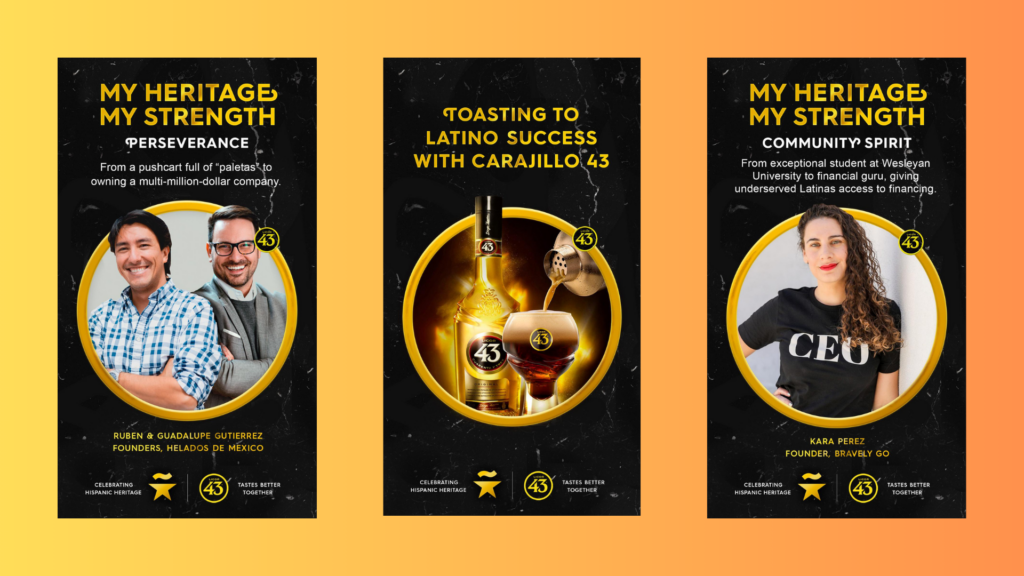
Licor 43’s “My Heritage, My Strength.” During Hispanic Heritage Month, Licor 43 partnered with Hispanic Star to celebrate Latino entrepreneurs. As the agency of record for Licor 43 USA, Social Revolt led development and execution, and the campaign reached over 1 million people with its message of unity, determination, and cultural pride.
6 immediate actions to take
- Start with local nuance. Customize by region and culture, not just language. One size fits none.
- Hire Hispanic creatives as strategists. Representation behind the camera matters more than representation in front of it.
- Invest in Spanish thoughtfully. Bilingual and Spanglish often outperform either language alone, so transcreate instead of translating word for word.
- Build mobile-first, always. Vertical video, fast load times, thumb-stopping creative.
- Show up on TikTok, YouTube, and CTV. That’s where the audience is, and where the growth is.
- Prove real impact. Partner with real Hispanic creators and tell meaningful stories. One-off Heritage Month posts don’t cut it.
Hispanic consumer insights: frequently asked questions
Why should brands invest in Hispanic marketing in 2026?
U.S. Hispanics represent a $4.4 trillion economy growing at 6.4% annually, nearly triple the non-Latino rate, and drove 68% of U.S. population growth since 2020. (2026 LDC U.S. Latino Economic Impact Report, Claritas 2025.) No other audience combines this scale with this growth trajectory.
Is marketing to Hispanic consumers just translating ads into Spanish?
No, and that’s the most common failure mode. Word-for-word translation sounds robotic and misses emotional nuance and humor. Effective Hispanic marketing means transcreation: writing for the culture first, often bilingual, with creative led by people who live it.
Are Hispanic consumers really one audience?
No. Mexican-American, Cuban-American, Puerto Rican, Colombian, Salvadoran, and other communities have distinct traditions, slang, histories, and media habits. Campaigns built on generic pan-Latino clichés consistently underperform culturally specific creative.
Where do Hispanic consumers spend their digital time?
YouTube, TikTok, Instagram, and streaming TV. Hispanics over-index on all of them versus the general population, average 3+ hours of daily social media, and use WhatsApp at more than double the non-Hispanic rate. (Nielsen, September 2025, Claritas 2025.)
What is the U.S. Latino GDP in 2026?
The 2026 LDC U.S. Latino Economic Impact Report (released July 2026) puts 2024 U.S. Latino GDP at $4.4 trillion, the equivalent of the world’s fourth-largest economy, with $3.4 trillion in income and $2.8 trillion in household consumption.
How young is the U.S. Hispanic audience, and why does it matter?
The median Hispanic American is 31.2 years old, compared with 43.2 for White Americans, according to Pew Research Center’s October 2025 analysis of 2024 Census data. The growth is homegrown: 32% of U.S. infants born in 2024 had a Hispanic mother or father, per CDC data via Pew. That youth gap is the engine behind everything else in this playbook, from digital behavior to long-term brand loyalty.
Does advertising in Spanish actually work, and what is the trap?
Yes, when done right: nearly half of U.S. Latinos, and 79% of college-educated Latinos, feel stronger affinity for brands that advertise in Spanish, while 65% remember brands that consistently speak to their community (Hispanic Sentiment Study 2025, We Are All Human Foundation). The trap is thinking you are marketing to one audience: Hispanic consumers do not share the same traditions, history, slang, or food, and word-for-word translations of English ads sound robotic. What wins is transcreation, writing for the culture first, often bilingual, often Spanglish, always intentional.
What did the 2026 World Cup prove about reaching Hispanic audiences?
June and July 2026 gave the clearest demonstration yet: half of everyone who watched the tournament used Telemundo’s Spanish-language broadcasts, from a community that is about 20% of the population (AdExchanger, September 2026). Roughly 9 million of the 25 million viewers of the U.S. team’s opener watched in Spanish, and Fox and Telemundo pulled in a projected $850 million in ad revenue (Marketplace, June 2026). The marketer’s lesson: brands that were not official FIFA sponsors outperformed the paid partners (Campaign, August 2026), so show up where the audience already is, since no official badge is required.
What immediate actions should brands take to engage Hispanic consumers?
Start with local nuance by customizing for region and culture, not just language, since one size fits none. Hire Hispanic creatives as strategists, because representation behind the camera matters more than representation in front of it. Invest in Spanish thoughtfully through transcreation, build mobile-first with vertical video and fast load times, show up on TikTok, YouTube, and CTV where the audience already is, and prove real impact by partnering with real Hispanic creators instead of one-off Heritage Month posts.
Beyond the data: make an impact
The brands getting this right share one habit. They build with people who live the culture, and they keep showing up long after Heritage Month ends. That’s the whole playbook, and the audience rewards it.
Connect with Social Revolt to build a strategy that connects, inspires, and delivers real results.
Sources
- Pew Research Center, “Key Facts About U.S. Latinos” (October 2025)
- U.S. Census Bureau, Vintage 2025 Population Estimates (via Conexión Florida)
- Claritas 2025 Hispanic Market Report (via TV Technology)
- U.S. Census Bureau, 2023 National Population Projections (via HipLatina)
- U.S. Census Bureau, Current Population Survey ASEC 2025 (September 2025)
- 2026 LDC U.S. Latino Economic Impact Report (via Business Wire, July 2026)
- 2026 LDC Report: U.S. Latino Consumer Market at $2.8 Trillion (via PR Newswire)
- Inaugural U.S. Latina GDP Report, 2026 (via HispanicPro)
- Hispanic Sentiment Study 2025, We Are All Human Foundation (via HispanicAd.com)
- Nielsen Diverse Intelligence Series (via Advanced Television, September 2025)
- Nielsen: 94% of U.S. Hispanic Fans Use Social Media for Football Content (via Advanced Television, May 2026)
- AdExchanger: Telemundo and the 2026 World Cup (September 2026)
- Marketplace: Advertisers Seize World Cup Ad Spots (June 2026)
- Campaign: World Cup Non-Sponsors Outperformed Paid Partners (August 2026)